10 Meaningful Ways to Carry Your Pet's Memory With You (Keychain Ideas & Pet Loss Keepsakes)
When a pet dies, the hardest adjustment isn’t the grief itself — it’s the sudden absence of small daily moments. No more click of nails on the floor in the morning. No one to greet at the door. No weight on the foot of the bed. Most grief advice talks about "moving on," but pet-parents who’ve lost a dog or cat they loved for a decade often want the opposite: a way to keep the presence, quietly, in the small moments.
That’s what keepsakes do. They don’t resolve grief and they don’t erase it — they give it somewhere to live. A thing your hand finds when you’re reaching for keys. A weight around your neck that’s there when you’re anxious. A portrait on the wall that watches the house. This article is a list of ten of those small, carryable, daily-presence keepsakes — from the obvious to the unexpected — for anyone looking for a way to keep a lost pet close.
None of these are "the right answer." Grief is specific, pets are specific, people are specific. Read the list and see which ones feel like yours.
1. A hand-carved leather keychain portrait
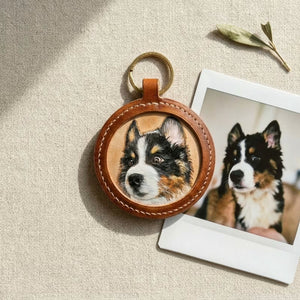
The one we make, so listed first with that disclosure. A leather pet portrait keychain lives on your keys, which means it moves with you every day without asking to be looked at. You find it a dozen times a day — reaching for the car, locking up at night, opening your front door. Unlike a pendant that sits against clothing, a keychain is held and let go, held and let go. It fits the rhythm of ordinary life.
For pet parents who don’t want to wear their grief openly but still want their dog or cat with them in the quietest daily way, a keychain is often the answer. Ours are hand-carved from your photos in full-grain leather — one piece, designed to outlast the rawest years of grief and still be carried in ten.

2. An engraved sterling silver pendant
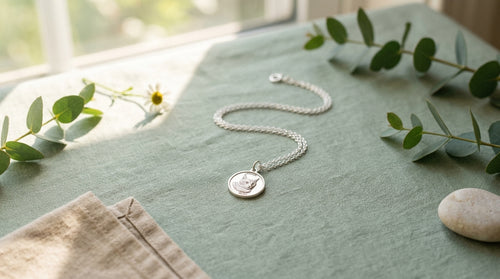
Worn on a chain or a cord, close to the collarbone, usually under clothing. A sterling silver pet pendant is the traditional memorial jewelry choice and it’s traditional for good reasons: silver is permanent, it’s light enough to wear every day without thinking about it, and wearing something under a shirt is emotionally different from wearing something visible. It’s a private gesture.
Options range from laser-engraved silhouettes of your pet to hand-engraved portrait pendants with fur-pattern detail. Our pet necklace line does hand-engraved 925 silver in 0.8″ and 1.0″ sizes, but several other good studios do similar work. Look for solid sterling (not silver-plated), and for engraving done on a single piece of metal rather than printed onto a sticker applied to metal.
3. A locket or compartment pendant with fur
For people who want something more physically tied to their pet. A small locket, compartment ring, or glass vial pendant can hold a lock of fur from the pet. This is a very old tradition — Victorian mourning jewelry often held human hair in similar compartments — and it survives because it works: you’re not just wearing a symbol of the pet, you’re wearing something that was of the pet.
Jewelers who specialize in pet memorial work can fabricate these, or you can buy a generic small-compartment pendant and have a trusted pet groomer or vet save a clipping in advance. If you’re considering this before a pet passes, save the clipping now — we’ve heard from many customers who wished they had thought of it earlier.
4. Ashes-infused keepsake jewelry
A step beyond the fur compartment: a small portion of ashes, cremation ashes, or nose-print imprinted into a cast ring, pendant, or bead. Several dedicated studios specialize in this category, working with pet parents directly via mail. Cost varies widely ($80–$400+) and the process usually takes 3–6 weeks.
This isn’t for everyone — some pet parents find it comforting, others find it overwhelming. Consider it carefully. A small gesture we’ve seen work for people unsure about it: order a simple engraved piece first, see how you feel about wearing it every day, then decide later if you want something with ashes incorporated.
5. A paw-print impression
Many vets offer a clay paw-print at the time of euthanasia — and if you didn’t receive one, it’s still often possible to make one from a living pet or even from a good photograph. The paw impression can be framed on its own, set into a ceramic tile, cast in bronze, or small-enough to wear as a pendant.
What paw prints do that portraits don’t: they capture something specific and physical — the actual size and shape of the paw that walked next to you for a decade. For some people, that’s the detail that matters most.

6. A wool-felt portrait frame
For people who want the pet visible in the home rather than carried on the body. A dimensional wool-felt portrait — where the pet’s face is sculpted from layered wool fibers rather than painted on a flat surface — sits on a mantelpiece or hangs on a wall and looks like the pet is there. Unlike a photograph, which flattens and fades into the scroll, a dimensional portrait has texture, shadow, and presence.
Our wool-felt frames are 6″ or 8″ and built for wall or desktop. If you’re choosing one for a grieving friend, we’d suggest asking first whether they want something prominent — a wall portrait is more emotionally confrontational than a keychain or pendant. For some people that’s exactly right; for others it’s too much.

7. A custom pet plush with specific markings
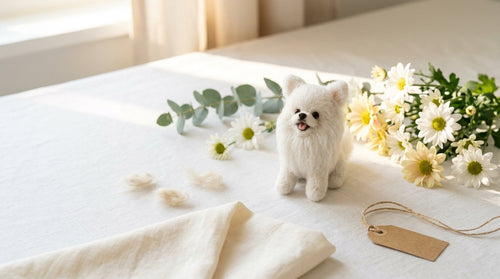
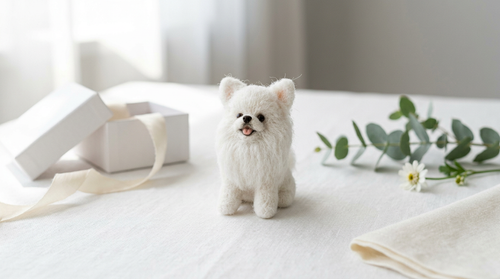
The one keepsake you can hug. A needle-felted plush made from your pet’s photos captures their specific face, markings, and proportions — not a breed stamp — in a form you can physically hold. For pet parents who miss the weight of their pet more than the visual absence, this is often the most comforting keepsake of all.
Plush pet keepsakes are a small industry; price ranges run from about $80 for small printed plush to $400+ for large needle-felted pieces from high-end studios. Ours are in the $139–$259 range, hand-felted in our studio. Whoever you buy from, look for needle-felted wool (not printed fabric) if you want the piece to outlive the grief.
8. A commissioned illustration or painting
Outside our product line but worth mentioning: a hand-painted watercolor or oil portrait of your pet, commissioned from an independent artist. Price range $50–$800+ depending on artist reputation and complexity. Delivery 2–8 weeks. Etsy is full of good illustrators; Instagram has even more.
What a painting does that a photograph doesn’t: interpretation. A good portrait artist will subtly emphasize the expressions that felt most like your pet — the slightly cocked head, the particular way the eyes softened when being looked at. Look at an artist’s portfolio carefully before commissioning; the style should feel right for your specific pet, not just be technically skilled.
9. A tattoo
For the most permanent option of all. Memorial pet tattoos have become increasingly common in the last decade, and good tattoo artists can reproduce everything from a realistic portrait to a minimalist line-art silhouette to a paw-print outline.
Things to know: memorial tattoos are easier emotionally if you wait at least several months after the loss — the grief is too raw at first, and the design choices you make in week one sometimes aren’t the ones you’d make in month six. Also: pick an artist who specializes in the style you want. A minimalist line-art specialist will not do realistic portraits well, and vice versa.
10. A journal, letter, or written keepsake
The least object-like option, but often the most powerful one. A paper journal in which you write about your pet — memories, specific moments, the first time you met, the last day, things they did that only you saw — becomes its own kind of memorial over time. Unlike a portrait, which captures a single frozen image, a written keepsake can hold the full complexity of the bond.
Some pet parents write a single long letter to their pet in the weeks after loss and then set it aside. Others keep an ongoing journal across years. There’s no right format. The only requirement is honesty. If you’re grieving now and struggling with object-based keepsakes (because the objects feel like too much), consider that writing may be the quieter and more sustainable form of remembrance.
Matching the keepsake to the moment
The ten ideas above divide roughly into three kinds of gesture:
- Private, daily, on-the-body: pendant, keychain, locket, ashes jewelry, tattoo. You choose these for yourself, for every day, usually carried close to the body.
- Public, in-the-home: framed portrait, wool-felt frame, plush, commissioned painting. Visible to guests; takes up space; invites conversation.
- Non-object: written journal, paw print on paper in a drawer, a song added to a playlist. Doesn’t have to be displayed or worn.
Many grieving pet parents end up with one from each category over time, not all at once. A keychain you carry from week one; a framed portrait you put up after three months; a journal you return to every anniversary. There’s no order. There’s only what you need right now.
If you’re buying this for someone else
Choosing a pet memorial gift for a grieving friend is genuinely hard, because you don’t know what form of remembrance they can handle. A few guidelines we’ve learned from customers:
- Smaller and carryable is usually safer than larger and visible. A keychain or pendant can be put in a pocket; a framed portrait demands to be displayed.
- Neutral colors are safer than bright ones. A muted leather keychain in natural tan reads as "memorial keepsake"; a vivid acrylic print reads as "commemorative merch."
- Ask, even awkwardly. "I was thinking of ordering you a keepsake — a pendant or a keychain — is that something that would help right now, or is it too soon?" is a kind thing to say. Most grieving pet parents will tell you the truth.
- Include a note. If they open a package they weren’t expecting, even the best keepsake can feel ambushy. Something simple written by hand: "I know how much [pet’s name] meant. I had this made for you. No rush to use it — just wanted you to have it when you’re ready."
Closing
None of the ten options above will make the grief smaller. What they do is give it a place — something the hand can find, something the eye can rest on, somewhere the bond can keep being carried even when the dog or cat can’t be. That’s the small, real job of a memorial keepsake: to let the relationship keep existing, quietly, in the part of life that goes on.
Whatever you pick, take your time picking it. The bond you’re honoring has been years in the making; the keepsake can wait a few weeks.
If you’re interested in our own memorial keepsake work, the full memorial gifts collection is here — four handmade formats (plush, pendant, keychain, framed portrait), each made from your photos with a preview before we ship. We also cover the psychology of why keepsakes help with grief in more depth in a separate article.
Frequently Asked Questions
What is the most meaningful way to memorialize a pet?
There is no single answer — it depends entirely on how you want to relate to the memory. Wearable pieces (keychains, necklaces) keep your pet with you in motion, every day. Display pieces (portrait frames, wool felt sculptures) anchor the memory to a place in your home. A custom plush satisfies a different need: something physical to hold. The most meaningful choice is the one that matches how you naturally want to carry grief and love.
How do I choose between a pet memorial keychain and a necklace?
The simplest split: a keychain travels with your keys and belongs in your hand; a necklace rests against your skin and belongs with your body. If you want to feel the weight of it every day without thinking about it, a necklace. If you want to see it every time you leave the house, a keychain. Many people order both for different emotional contexts.
Can custom pet memorial gifts be made from old photos?
Yes — even decades-old photos work as long as the fur color, markings, and face are clearly visible. Scanned printed photos, photos taken by old phones, even black-and-white photos (for engraved pieces) are all usable. The key is image clarity of the face and markings, not photo format or age.
How much should I budget for a custom pet memorial gift?
Furfond's range: Keychain ($229), Necklace (from $79), Portrait Frame (from $249), Custom Plush (from $139). Across the wider market, expect $15–50 for mass-produced items (printed acrylic, digital downloads) and $80–500+ for handmade artisan pieces where a person studied your specific pet. The price difference is human time. For a once-in-a-lifetime memorial piece, handmade tends to be the choice people don't regret.
How long does a custom pet memorial keepsake take to arrive?
Handmade pieces at Furfond: keychains and necklaces take 2–3 weeks to craft plus 5–14 days shipping (3–5 weeks total); portrait frames take 3–4 weeks plus shipping (4–6 weeks total); custom plush takes 3–5 weeks plus shipping (4–7 weeks total). If you're ordering for a specific date — an anniversary, a birthday, a "gotcha day" — order at least 6 weeks in advance to be safe.